Refractometer for Battery Acid, Coolant, Windshield Washer Fluid, and AdBlue Testing
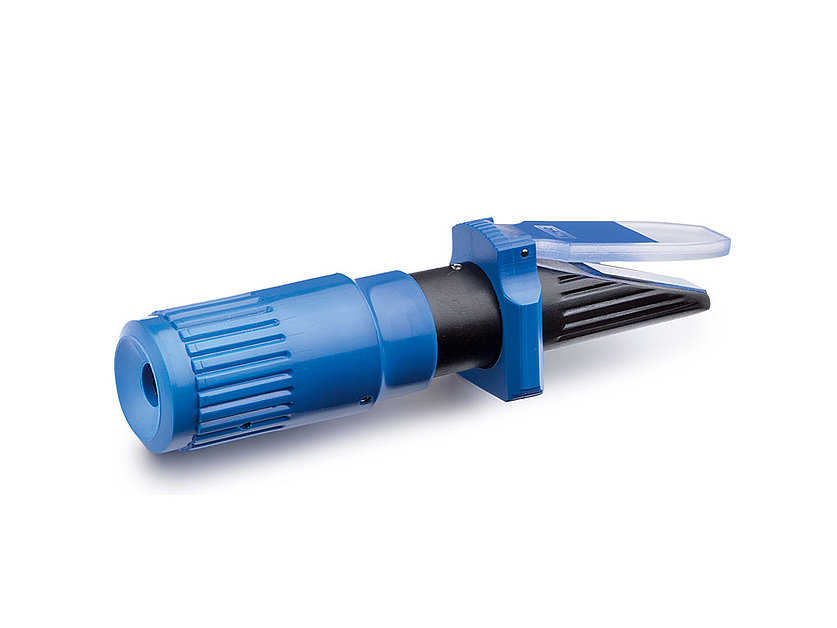
This professional refractometer is a versatile and precise measuring instrument specifically designed for the quick and accurate quality check of critical fluids used in motor vehicles. It is an ideal choice for service stations, workshops, and professionals who require reliable diagnostics to determine the specific gravity of battery acid, the freezing point of coolant, the alcohol or ethylene glycol content of windshield washer fluid, and the concentration of AdBlue (carbamide solution).
The device operates on an optical principle, is extremely user-friendly, and provides immediate, easily readable results thanks to the built-in scale. The robust design and excellent optical elements guarantee a long service life and reliable operation even under the most intensive workshop conditions.
Key Features and Advantages
This refractometer has been optimized to increase workshop efficiency, offering several advantages to users:
-
Multifunctionality: Four different fluid types can be checked with a single device, thus reducing the number of required tools.
-
Fast and Easy Handling: The measurement can be performed in a few seconds: place a drop of the sample on the prism, turn it towards the light-protected area, and read the result through the eyepiece.
-
Excellent Optical Quality: The clear, high-resolution optics ensure a sharp reading of the boundaries, minimizing the possibility of human error.
-
Automatic Temperature Compensation (ATC): The built-in ATC system automatically corrects for measurement deviations caused by temperature fluctuations (usually between 10°C and 30°C), ensuring accurate results across a wide temperature range.
-
Robust Construction: The device body is made of durable materials, resistant to the rigors of the workshop environment.
-
Focus adjustment: A focus ring, adjustable to the user's vision, assists in precise reading.
Application Areas and Measurement Scales
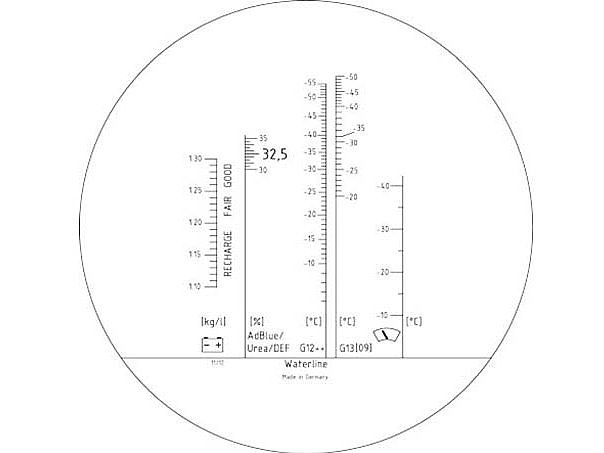
The refractometer scale contains several independent measurement ranges, each calibrated for specific fluids:
| Fluid Type |
Measurement Range |
Unit |
Pontosság |
| Battery Acid (Electrolyte) |
1.10 – 1.40 |
sg (relative density) |
±0.01 sg |
| Coolant (Freezing Point) |
-40°C – 0°C |
Celsius (°C) |
±5°C |
| Windshield Washer Fluid |
-40°C – 0°C |
Celsius (°C) |
±5°C |
| AdBlue (Urea Solution) |
30% – 50% |
% (volume fraction) |
±5% |
Detailed Application Descriptions:
1. Battery Acid (Electrolyte Density)
The refractometer allows for quick checking of the charge status of lead-acid batteries. The measured specific gravity (sg) directly indicates the electrolyte concentration, which determines whether the battery is fully charged, partially charged, or discharged.
2. Coolant Freezing Point
The freezing point scale helps check the frost protection of the coolant (usually based on ethylene glycol or propylene glycol). This is particularly important in winter periods, as well as for checking the mixing ratio of different coolant fluid types (e.g., G11, G12, G13).
3. Windshield Washer Fluid
This part of the scale measures the freeze protection capability of the washer fluid. It allows for a quick assessment of the effectiveness of alcohol-based or glycol-based fluids, ensuring the system remains protected from freezing in winter.
4. AdBlue (DEF – Diesel Exhaust Fluid)
Checking the quality of AdBlue is essential for the proper functioning of the SCR (Selective Catalytic Reduction) system in modern diesel vehicles. The refractometer measures the carbamide concentration in volume percent (%), ensuring the solution complies with strict NOx emission standards. AdBlue with an incorrect concentration can damage the catalyst and the injection system.
Technical Data
| Parameter |
Spezification |
| Measurement principle |
Optical refraction |
| Temperature Compensation |
Automatic (ATC) |
| Operating temperature range |
10°C – 30°C (compensated range) |
| Prism material |
Glass |
| Body material |
Metal/Rubber coated (the exact material composition according to the manufacturer's specification) |
| Focusing |
Adjustable eyepiece |
| Calibration |
With distilled water (zero point adjustment) |
| Accessories |
Pipette (for sample dispensing), Calibration screwdriver, Cleaning cloth, Carrying case |
Operating Instructions Summary
-
Cleaning: Wipe the measuring prism clean with a soft, clean cloth.
-
Sampling: Using the included pipette, apply a few drops of the liquid to be tested onto the prism. Ensure the sample completely covers the prism surface and contains no air bubbles.
-
Readout: Point the refractometer towards a strong light source (natural daylight is ideal). Look through the eyepiece and adjust the focus until the scale becomes clearly visible.
-
Interpretation: The boundary line (separation of the blue and white area) precisely indicates the measured value on the appropriate scale.
-
Cleaning: After every measurement, immediately clean the prism with distilled water to prevent corrosion or loss of accuracy due to residues.
This refractometer is an essential tool for any professional who wants to guarantee the optimal condition of fluids in vehicles, thus contributing to the long life of the engine and compliance with environmental regulations.